
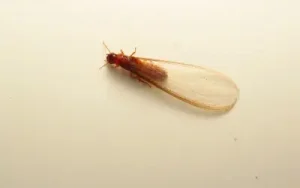
Winged termite – note the cylindrical shape of the body and straight antennae.
Both ants and termites can have wings, and when they do, it can be very difficult for the untrained eye to tell them apart. If you see one crawling around in your home or near it, it’s only natural to wonder if you have termites or if you can breathe a sigh of relief because it’s just ants. Fortunately, ants and termites have many differences, which can help you tell them apart, too.
Here, we’ll compare flying ants and termites, so you can be in a better position to correctly identify which is which and spot problems early.
10 Ways That Flying Ants and Flying Termites Are Different
1. Shape of the Body
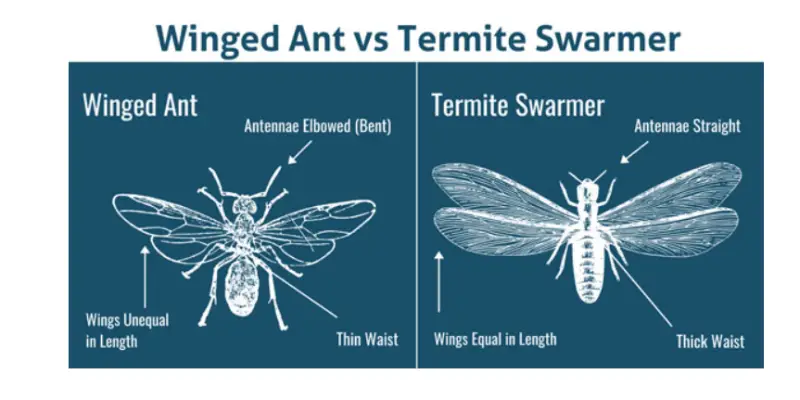
Ants’ bodies have distinct segments – the head, thorax, and abdomen – with a narrow waist area. Termites have a tube-like body that doesn’t pinch at the waist.
2. Antennae
Both winged termites and ants have antennae, but with slight differences. Termite antennae are straight and have a slightly beaded appearance. Ant antennae are bent, resembling an elbow.
3. Wings
Both ants and termites have two sets of wings. Termite wings are much larger, longer even than the termite’s body, and both sets of wings are the same size. Ants have a front pair of wings that are larger than the rear wings.
4. Color
Most ants are black, brown, red, or some combination. Termites are much paler in color, as they spend their lives deep within the structures of wooden buildings or underground, where they don’t receive much sunlight.
Ready for your INSTANT quote?
Click the button below to leave your information and we’ll be in touch with a free quote!
5. Foraging Behavior
Ants will never be accused of being shy. Workers will follow a pheromone trail pretty much anywhere in pursuit of food to forage. They’ll march across your kitchen counter, floor, or even up your walls, any time, day or night. Termites are seen much less often. They often build mud tubes that they travel in.
6. Nesting Behavior
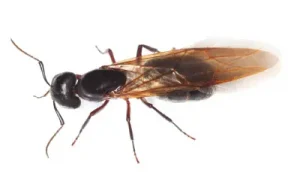
Winged carpenter ant – note the elbowed antennae and narrowing at the waist.
Sometimes, ant nests are obvious, like an anthill in your front yard. Sometimes, they nest within the walls of your home, where they’re much harder to find. Termites exclusively build nests in wooden structures or deep underground, living and feeding deep within a structure, sometimes for years before they’re discovered.
7. Swarming
Flying ants and termites are similar in this regard. In both the termite life cycle and the ant life cycle, there are reproductive members that fly from a nest to establish their own. These swarmers swarm together, mating in an area for a short amount of time, then disperse. If you see one of these swarms, keep your eyes open for potential signs of infestation.
8. Damage to Property
Termites are notorious for damaging property, and it’s essential for Orlando homeowners to learn how to recognize termite damage.
Termites are the most destructive pest in the United States, costing homeowners billions of dollars in damages every year. Most ant species aren’t destructive. They’re annoying and unhygienic, but for the most part, they don’t cause property damage. Carpenter ants are an exception; they also cause damage to wood.
9. Debris They Leave Behind
Carpenter ants and termites both leave behind a material called “frass,” which has a consistency like sawdust. Subterranean termites also leave mud tubes as evidence of their presence. These are about the diameter of a pencil and brown to gray in color.
There are many signs of a termite infestation, whereas with ants, you usually see the ants themselves.
10. Discarded Wings
Termites shed their wings en masse right after their swarm. It’s common to find large piles of these wings in areas that are infested. Ants also shed their wings, but typically not in large piles like termites.
Need Help Telling Termites and Flying Ants Apart?
Being able to tell harmless ants from much more dangerous termites is an essential skill for any homeowner. We hope this article has provided some helpful tips you can easily apply.
If you’re still having trouble telling apart termites from ants in Orlando, you can always give Heron Home And Outdoor a call. Our technicians will perform a free inspection, identifying any active pest issues and making recommendations for how to move forward.
Got questions about ants, termites, or any other kind of pest? Ready to schedule an appointment? Give us a call today.